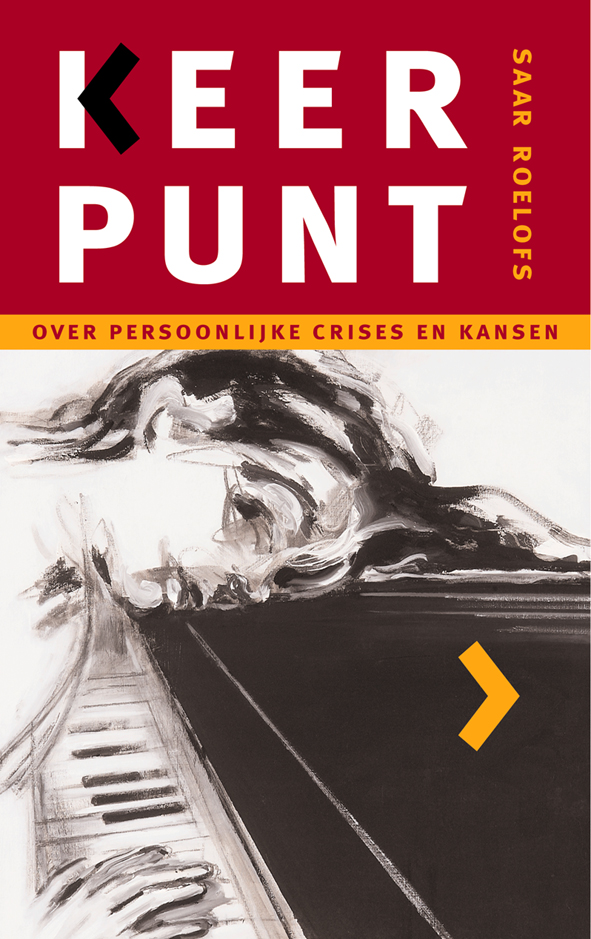
TURNING
POINT
PRESS Publisher: Ten Have, 2004 |
|
|
We
never know how high we are Emily Dickinson |
|
|
"Roelofs has been listening and watching very well. The interviewed persons come "A series of remarkable interviews."(professional journal: Care and health) |
TURNING POINT is based on interviews with eleven individuals (5 men and 6 women) who have shown how personal crises or traumatic experiences set them in motion and offered opportunities to give their lives a new direction.
Crisis as an
opportunity
|
|
|
In Turning point the central principle is that adversity offers an opportunity for development—regardless of the nature of the issues. No hierarchy of suffering is established. The question. The death of his young son forced General Practitioner Pieter to think differently about his life and his profession. Since then, he has offered more personal care: less technical, more with heart and soul. His personal quest resulted in many initiatives in the field of healthcare. The Letter. Sandra is a depressed, suicidal young woman. When she writes a farewell letter just before a well-prepared suicide attempt, she becomes convinced that her death wish is due to a traumatic childhood and decides she wants to live. Afterwards, she processes her experiences and publishes about them in a mental health journal. She touches many readers with it and finds fulfillment in her life. The Big Money. Maurice comes to the Netherlands from Suriname at a young age. Feeling inferior and penniless, he ends up as a dealer in the drug scene. He looks up to the smooth, tough Surinamese guys in that scene. When he is arrested, detention follows. Afterwards, he finds a job where he uses his experiences to prevent young immigrants from going down the wrong path. He is proud of his honestly earned money. He no longer feels dependent on others for his self-respect. The Arrest. Police Officer Mario is stabbed during an arrest. He develops post-traumatic stress disorder (PTSD) and enters therapy. Gradually, he allows himself to feel his emotions. While he was initially not angry at the perpetrator, the anger is now unleashed. After processing the traumatic experience, he is more assertive, socially aware and engaged in life. He begins to talk about his experiences at the police academy. This turns out to be well received. "I simply transformed that stabbing," says Mario. A quiet place. Artist Emma grows up in fear. Her mother has obsessive thoughts about illness and death, and her father is a volatile man with a violent temper. In her teens, she suffers from panic attacks. In her adult life, she clings to men. After the end of a destructive relationship, she is overwhelmed by years of pent-up anger and grief, which she gives form to in her art. "It was a violent awakening," says Emma. "All that misery was ultimately necessary to let go of the fear." Work and passion. Human Resources Manager Philippe loses his job during a mass layoff, becomes depressed and goes into therapy. There, he learns to allow his anger. He discovers that anger is not necessarily destructive, but is also a force. He then decides to make a virtue of necessity and starts an unpaid initiative to support the unemployed. That work offers him more satisfaction than he ever experienced in paid jobs. Looking back, Philippe says that his dismissal was "a blessing in disguise." The High C. As a child, singer Suzan was frequently sent to children's homes due to her mother's illness. At home, she was often beaten. As an adult, she built a successful career as a classical soprano. Until she realized that she could only sing high notes as long as she cut herself off from her feelings. So she was "eternally cheerful." At a certain point, she had to force herself on high notes. But she did not want to give up her glamorous status as a soprano. Until she became depressed. Then she entered therapy, during which she processed her painful childhood memories. Afterwards, she decided to continue her singing career as a mezzo-soprano. While this meant she lost her position as the leading lady, it also allowed her to blossom fully.
Cement. After
spending four and a half years in Nazi concentration camps, Bill (Sebil)
Minco (1922-2006) returned "in pieces." However, he refused to feel like
a victim and was convinced that his suffering had not been in vain. For
the rest of his life, he tried to piece his fragments together. He
called his attempts "cement." This included, among other things, his
refusal to hate Germans. In his life as a businessman and politician, he
used his camp experiences in a positive way. The cement with which he
held his own fragments together turned out to be the same cement with
which he built bridges between people. The stories have been authorized by all interviewees.
|
||
|
|
Interior
Solo Identity
|