Below a translation in English of Part 3: The
resiliance of the helpseeker
In Part 3 of Who
is crazy, actually?, using various real-life examples, Saar Roelofs shows that people in psychological distress
- even without the intervention of mental health care professionals - are capable of tapping into unsuspected inner strengths.
According to the author, art is a source of inspiration that can contribute to insight and spiritual growth. Consequently, the reader will find many references to visual art, literature, and music in the book.
Reviews
"Saar Roelofs focuses on the creativity and resilience of patients. She also refers to the resilience of artists and Holocaust survivors. She rightly points out that people in exceptional situations often exhibit enormous growth potential, from which we as therapists can still learn a great deal."
(Dutch) Journal of
Psychiatry 5, 2009, Patrick Luyten
"An extraordinarily supportive message for everyone in psychological distress." Zinweb, July 6, 2008, Marga Haas.
A justified argument against making people dependent on professional care. Illustrated with original cartoons that provide clarity. Lively case studies.
Dutch Journal of Medicine
December 13, 2008, PC Bügel.
Who is
crazy, actually? (2008) together with Saar Roelofs' book Don
not disturb (1997) and her
E-document No Talent for
conformism, my experience as a psychologist in the mental health care (2024), forms a
critical, still relevant triptych on mental health care.
The case descriptions
in this textare – apart from the references to well-known visual artists, writers, and composers – based on personal conversations.
Where necessary, names and details have been changed to ensure anonymity.
Is Robert Schumann crazy if he is in a manic state in four days time composes his delightful
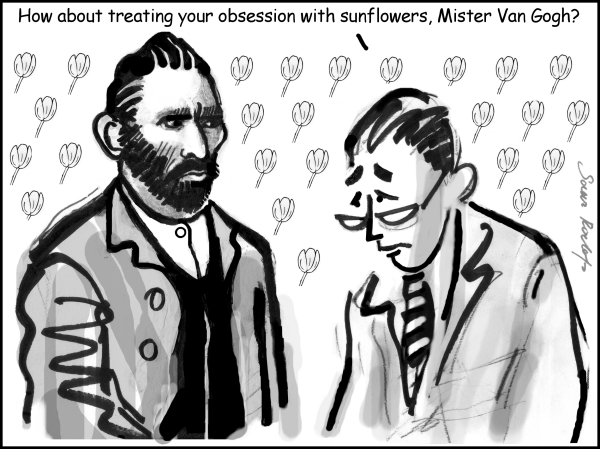
Frühlingssymphonie? Is Vincent van Gogh disturbed when he with intense colors and vigorous brushstrokes grimly pursues maximum expression? Is a child, who is furious resistance against what it perceives as injustice, sick?
Highs and lows
No matter how much he may be in psychological difficulties, a human being
also has healthy and vital aspects.
Therapists can utilize these aspects.
Instead, they often emphasize the
psychological problems and the inability of their client.
There are characteristics that in the helping professions are often exclusively seen as
negatively, but which can also have their positive sides. People with a fiery temperament, for example, have
usually a life with recurring highs and lows.
They can not only dig themselves into a hole, but also move heaven and earth to
enrich their lives However, therapists provide them
often very quickly of a psychiatric label that draws attention to
the lows and that does not do justice to the
highs. In doing so, they ignore the
healthy side of a nature in which the remedy for the less healthy
side is stored. Here are a few examples.
Vitality
Sonja is a fighter. She is the youngest of five children and is growing up with
little joy in it. Her father is a sensitive and shy man with a
war trauma for which he spent a long time in a psychiatric hospital. There he ends his life. She describes her mother
as loveless and capricious. Sonja, however, is not easily intimidated.
"Even as a toddler, I could burst into tears or throw a tantrum when I didn't feel accepted. If I felt something was unjust, I went on and on until I got my way. So I didn't give up.
Just like that. I just wanted to be recognized."
When her older brothers and sisters leave home, the situation is
sometimes unbearable between Sandra and her mother. But Sandra is not
girl who keeps her mouth shut and conforms.
I hated her and I hated the whole world. It was very intense.
She
was afraid that I would kill her, and conversely, I was afraid that
she would kill me. On a few occasions, she completely
freaked out. Then she was dangerous. Then she would hit me, for example, with the
rod of the vacuum cleaner.
Slap.
slap, slap! But I threw myself
completely into the fight, to the point of exhaustion. I wasn't taking anything anymore.'
As a young adult, Sandra hits rock bottom. She goes into therapy.
During the treatment, she discovers that her temperament is her great strength. That it was her only means of surviving the home situation. And
also that she uses that same vitality to create beautiful things. Thus she plays significantrole in the Clients'
Union for Mental Health Care,where she is appreciated for her ingenuity. For the bulletinfor the Clients' Union she writes many articles that
form important contributions.
From the heart
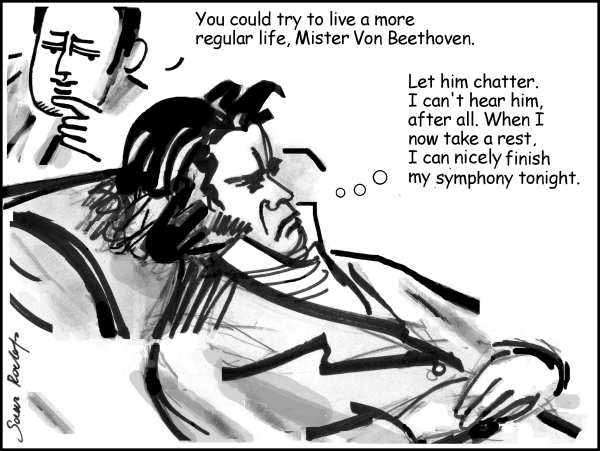
Who doesn't know the bust of Beethoven with the fierce head and wild hair,
who adorns many a piano? Beethoven was a hot-tempered person with
enormous mood swings. With his recurring fits of rage
he was a difficult person, not only for himself, but also for
his surroundings. The story goes that he was once desperately working on a composition,
the
Credo of his Missa Solemnis. Because of this he became
so engrossed that he the dinner that his maids
had prepared, forgot. It was not until after midnight that the composer felt hungry and he requested his meal. In
Doctor Faustus, Thomas
Mann (1875–1955) describes
Beethoven's despair as follows:
The deaf man sang, wailed, and stamped while he bent over the Credo – it was such a terrifyingly gripping sound that it the to the
door listening [maids] made the blood run cold in the veins.
However, just when they had wanted to withdraw in deep reverence,
the door
had suddenly opened, and Beethoven stood by the
doorway, – and his appearance? Terrible! In neglected clothes,
the facial features so distraught that it inspired fear, with lurking eyes, confused and distracted, he had stared at them and
gave the impressio tTo have
been through a life-or-death struggle(…)
When the composer subsequently
found a cold, charred meal on the stove, he burst into an extraordinarily violent rage that
lasted five to six hours, roaring incessantly:
"Could you not watch with me one hour?"
But with what immense
dedication and ingenuity has Beethoven translated his fluctuating moods
into music. For example
in his famous
Ninth Symphony. The contemplative and
comforting third movement has barely faded when we are startled by a devilish dissonance in the brass, accompanied by thunderous
timpani, followed by a fierce argument from cellos and basses.
After this outburst, a lighter passage begins that becomes increasingly exuberant, after which the diabolical dissonance rears its head again.
But Beethoven immediately interrupts himself. At the top of his lungs
a singer exhorts for more joy:
‘O
Freunde, nicht diese Töne! Sondern laßt uns angenehmere anstimmen, und
freudenvollere.’And then
the jubilant final chorus follows Schiller's poem
Ode an die Freude met
the well-known All Menschen
werden Brüder where the sparks of joy
fly off.
All that in a time span of less than ten minutes.
And we think it's beautiful!
With his music, Beethoven not only pleases his listeners,
he derived satisfaction from it himself as well, as evidenced by the words he wrote above the manuscript of his
Missa Solemnis: 'From the heart –
that it may go to the heart again.'
When Beethoven presented himself as an unknown contemporary composer with
his rapidly changing, intense moods to the mental
health care, the
therapist might perhaps
have only seen a disorder – perhaps of the type 'borderline' – without even suspecting in what exceptional way
the composer translates his mood swings into music.
After a successful treatment, the symptoms
the client initially sought therapy for have diminished or
disappeared. The client is once again able to pick up the threads
of his or her live. Ideally, the therapist has provided tools that
enhance the client's independence, enabling him or her to take
charge of his/her own life - tools that remain of lasting value after
therapy concludes. Life goes on, after all. There
will always be new experiences, new challenges, and new problems
that require a solution. A therapist is not a partner or coach who
guides a client year after year. Instead, therapists can help their
clients develop the therapist within themselves, teaching them to
mobilize their resilience - when necessary- and find their own
solutions to problems. As the renowned psychologist
Carl Rogers (1902–1987), founder of Client-centered Therapy,
formulated it: the client possesses all the necessary resources for
change within themselves, and solutions are within his or her
reach. In this way, therapy serves as a stepping stone to
self-reliance.
Roly-poly toy
Intensive treatment is not always necessary to
achieve independence. When there is no profound or
persistent psychological distress, a gentle push in
the right direction is sometimes enough. A
therapeutic method can be an eye-opener for a
client. An example.
When dealing with
emotional pain, it can be useful to change
course. After all - as scientific research
into positive emotions shows - joy
activates. It broadens one's perspective and
expands the imagination. Healing energy is
released. But this does not mean that
negative emotions should be denied, because
then they will reverberate as a disturbance.
Many people, however, are
inclined to desperately suppress emotions like
sadness, anger and fear. This can block a person's
energy to such an extent that - despite their
attempts at an optimistic outlook - they feel
depressed, agitated or tense. In a brief therapy, a
client can learn that going along with the pain is
sometimes wiser than resisting it. That, by focusing
on the pain for a defined period, its intensity
decreases. That they can subsequently view it with
detachment and calmly investigate its underlying
causes. When clients experience within the safe
context of the therapy room that, after letting go
of their emotions, they always return to their
center like a roly-poly toy, this can be a 'remedy'
for the rest of their lives. In this way, therapy
serves as a prelude to increased independence.
However, a therapist who
relies too little on his or her client's stabilizing
capacity and views every negative emotion as a
psychological problem fails to see the client's
inner strength and keeps him or her dependent longer
than necessary.
When the
time is right
Sometimes a therapist has given his or
her client all the tools necessary for
change, but the client is not yet able
to utilize them. The time must be right
for this. This may not even be the case
until a client no longer sees a way out.
I will take Lucy as an example. When
she is in her late twenties and renting
a room, Lucy becomes suicidal. She goes
into therapy, but her therapist
disappoints her time and time again.
After two suicide attempts, she ends up
with an independent female therapist by
whom she feels respected and understood.
Lucy talks about her life. About her
bleak childhood, her erratic mother, her
father's depressions, and her longing
for death. Her therapist explains to her
that her current feelings of fear,
sadness and anger can be traced back to
her childhood traumas. They also discuss
whether there is anything left for Lucy
to live for. This is difficult and
painful for both of them. "The outcome
could also have been that there was
nothing left. That she wouldn't see me
at the next appointment," Lucy says.
Ultimately, Lucy feels she cannot
continue. Before making any further
decisions, she writes her therapist a
long farewell letter.
"At
one point while I was writing, there was a breakthrough. My therapist had always
told me that my not wanting to live anymore was also caused by my mother. That I
had heard her say too many times that I was bad. I thought that was such
nonsense! I started writing that down too. Back then I wondered: how does that
work exactly? While writing, I discovered there was some truth to it after all.
That I am actually not that bad. That my death wish stems from anger, hatred and
longing. I realized that I actually did want to live, but that I was afraid of
life. I didn't give myself a chance. Had never given myself a chance. And
suddenly, I no longer wanted to be some kind of Jesus who lets himself be nailed
to the cross and then also says: oh, father, forgive them for they know not what
they do. The fact that I had become this way was due to everything I had been
through. I suddenly saw that then. I had heard it all, what my therapist said,
and I could understandt
with my mind. But I didn't feel it. I really had to feel it myself! While
writing, it sank in for the first time. If all that misery hadn't been there, I
probably would have been a completely different person. A very happy and
spontaneous person. Someone who
did want to live! I had never
really tried... Then I called my therapist and said: I will be at our
appointment."
By now, Lucy has completed her therapy and found her balance. "It is not that I am a very positive person now, that I
have a hallelujah feeling. But now I sometimes feelreally very complete."
When dealing with mental health issues, it is not always necessary to
call in a professional counselor. The following three examples
demonstrate that professional solutions can also be found outside the
mental health care sector.
A dedicated husband
The first example shows how a loving
husband deals with his wife's concentration camp experiences. It
concerns the story of Ronnie. Her caregiver takes the
responsibility for her own life out of Ronnie's hands, thereby
blocking the path to recovery [see Part 2
Proximity: Salvation]. Ronnie's second
husband, a businessman, however, intuitively helps her in a
professional manner. He uses a technique that corresponds to
exposure therapy, a treatment often used for anxiety disorders.
This method entails the therapist confronting the client
step-by-step with their fear in a safe context, causing the
stimuli that evoke the anxiety to gradually decrease in
intensity.
"Whenever my husband noticed me going quiet or tensing up,
he would ask if something was bothering me. For instance, we
were once driving on a highway with those orange neon
lights. That strange, orange glow that strips away all
colors was something I had first seen in Auschwitz. Because
of it, everything looked ghostly. It was so terrifying! I
panicked, but I couldn't utter a word. My husband pulled
over and asked what was wrong. When I told him what scared
me, he calmly explained that it was just streetlights. He
said: 'Just look around you. That light has nothing to do
with the camp.' Afterwards, we just sat there together until
my fear subsided. We also once walked into a yard
with freight cars. My husband then said: 'Look, those wagons
are empty. They are only used for transporting materials.
You never have to go inside them again. That is all in the
past. Go ahead and touch them. Nothing will happen.'
Step by step, that is how he taught me to overcome my fears,
because then I was able to reason through them. Whenever I
felt uneasy, I would ask myself why that was. I would then
pay close attention to whether there was anything in my
surroundings that triggered memories of the camp. A specific
object. A sight or sound. A smell, or someone saying
something. Then I would try to examine it. Once I figured
out what was going on, I would tell myself: this is not
threatening. This situation is not directed at me. This has
nothing to do with me. Then the fear would subside. This
way, I gradually became better and better at managing my
fears. I still carry the images of my past in the camp with
me, but I can handle them now."
Self-help book
There are many good self-help books on the market that can make
the path to a professional counselor unnecessary. Below is an
example of a woman who finds lasting support in a self-help
book.
Francine and
her husband Rick's marriage is suffering from tension and arguments.
Rick is regularly unfaithful to Francine, but after his 'adventures'
he always returns to her. That is, until he tells Francine one day
that he is 'on cloud nine'. He has found his 'true love' and wants
to move on with her. Francine is completely devastated. At night she
lies awake worrying; during the day she is tired and depressed. A
self-help book offers her support. Through this book, she is
introduced to a Buddhist attitude that has been incorporated into
contemporary therapeutic practice under the name
mindfulness: an
intense orientation towards the present experience, a non-judgmental
acceptance of, and surrender to, the moment.
"Around
that time, I was reading a book by a Buddhist monk.
A Vietnamese man, I don't remember his name. I happened to
get it from my sister. And it came at exactly the right
moment. That book became my spiritual
anchor. Every day, I read in it about how to handle negative
feelings and thoughts. I reflected on it over and over
again. It was absolutely not a
theoretical book. I could really apply it in practice. It
contains tips about daily situations. How to deal with all
kinds of emotions. With anger, jealousy, or whatever. How
you can change those feelings in a way that benefits you.
For example, when you are furious, not saying: oh, how
annoying. But asking yourself:
why am I
furious? Actually making a friend out of the anger. Then you
don't suppress it, and you start looking at it in a
completely different way. Then you can gradually accept the
anger. Then you start asking yourself: What is this anger
doing to me? What is it doing to others? How does it serve
me? It
also contains a breathing technique that calms you down,
which I still use. Two or three times a day for a few
minutes. When inhaling, you say to yourself: I am becoming
calm. When exhaling, you smile. I also often did it in front
of the mirror, and then I would think: oh right, I don't
look completely depressed yet, I can still smile. I found it
very important that I could still evoke something positive
within myself like that. It also contains
exercises on how to completely clear your mind and be very
focused on what you are doing. To live in the here and now
at that exact moment. Not in the past, not in the future,
but in the now. Right now it is like this, right now I feel
that, right now I need to breathe properly and pause during
this situation. That is the essence of the book.
It was hard work sometimes. A whole spiritual process. Not
just staying stuck in your negative feelings and wallowing.
No! Because besides that, there is also something else.
Without that difficult situation with Rick's girlfriend, I
wouldn't have learned that. I now know: if I have problems,
I can fall back on that, because I've experienced it and
saved it in my system. Then I'll grab that book and I know
exactly how to do it again."
[The Buddhist monk Francine speaks of is very likely Thich Nhat Hanh, a
well-known Vietnamese monk. S.R.]
Peer support group
People can
also find support among others with the same problems in a
so-called
peer support group.
Peers recognize and acknowledge each other's grief, pain, and
despair. That alone can sometimes be a huge relief. This can
involve a group of people one actually meets or a group one
visits online, as there are numerous websites about specific
psychological problems where people can read about the
experiences of others in the same situation and get in touch
with them.
Below is an example of a woman, Helen,
who experiences a great deal of support and joy in her peer
support group. Helen is married and a mother of two daughters.
Her husband, Elco, is an insurance agent and travels a lot.
Helen takes care of the household and raises the children. When
she is in her late forties, she goes through menopause. The
menopause coincides with the children leaving home. Helen does
not suffer from the so-called 'empty nest syndrome'. She
previously struggled with a 'full nest' and is glad the children
have moved out. Now she has more time for herself. The hot
flashes do not bother her either. They only last a few minutes
and then they are gone.
However, she is afraid that Elco no
longer finds her attractive and becomes intensely jealous. That
is her problem. When she is home alone during the day, she
becomes obsessed with the thought that he is cheating on her
with younger female clients. Sometimes she completely loses it
and spies on Elco during his visits to clients. Elco is always
full of understanding, but that offers no solace. She becomes
depressed. Then she reads about a peer support group.
"I once read in a neighborhood
newspaper about a so called Vido group at the community
center; it's a support group for women going through
menopause that meets once a week. Elco said, “Wouldn't that
be something for you, then you'll get to know other women.”
That would allow me to talk to other women who were in the
same situation as I was. Then I started hesitating. One
evening, I plucked up the courage. The first time, I just
sat and listened. The second time, I wanted to become a
member, and then all the women took turns telling why they
had joined the Vido. That they had physical complaints, that
they felt less attractive, that they wanted to meet other
women. And there was one woman who was also very jealous.
Who even followed her husband to work. That sounded very
familiar to me. Then I thought: oh, luckily I'm not the only
one!"
The Vido group offers Helen more
than just recognition. The group also organizes creative
afternoons and gymnastics to keep the body supple during
menopause. And above all, it offers good company. Helen has
made a few good friends there with whom she regularly goes
out and goes on vacation. And finally, because she feels
less dependent on her husband, she is better able to stand
up for herself in her relationship with Elco.
People do not
have to be passive victims of their disposition or circumstances.
They can shape their own lives. Currently, a number of methods - in
fact, centuries-old ones - are in vogue that capitalize on this
possibility.
The Secret is one
such method. In short, it entails the following:
Human beings are the creators of their
own lives. They attract whatever their attention is focused on.
If you want to change your life, you need to change your
thoughts and beliefs. You do this by articulating your wishes
and desires clearly and specifically. Next, you engage all your
mental power and imagine your wishes coming true. You must
desire this with all your heart and soul. In doing so, you try
to experience it as much as possible: by seeing, feeling, and
hearing. You do need to be aware of the things you have already
acquired in order to materialize your wish, while also opening
yourself up to new things in your life so you can recognize to
what extent your wish is being fulfilled.
The
descriptions of how
The Secret
works raise high expectations. However, a quick path to the
fulfillment of their wishes is usually not an option for people
with psychological issues. Processes of change generally involve
trial and error.
Crisis as an opportunity
People are often only able to turn
their lives around in a positive direction when they find
themselves in an inescapable situation. When they hit a wall.
When they are confronted with a fait accompli that
makes it impossible to continue their old, familiar way of life.
Then, they must accept the situation as it is. If they cannot
shape the circumstances to their will, the only thing left to do
is change their perspective. In this way, they are forced to
face the fear and pain they often tried to escape for a long
time – the starting signal for a new beginning. Then, they can
undergo a process of growth that yields important insights. They
realize that their trials serve a purpose.
It is
possible that they will then discover a coherence they did not
see before. The common thread in their lives. Later, when
looking back on the crisis, they realize that the insights they
gained have made their lives richer and more valuable. It is not
without reason that the Chinese word for crisis –
wei-ji – is
composed of two characters: one for 'danger' and one for
'favorable opportunity'.
Or in the words of Francine, whom I
introducedearliar under the heading Self-help book:
"That difficult situation showed me
that I can function well in problematic situations. That only
then do I truly bring out my strengths. Perhaps I usually use
too little of my energy or potential, as they are not usually
tapped into. I am often introverted, modest, and insecure. But
when I have to, I can develop the opposite. I can show the other
side. And in a crisis, well, you have to become resourceful.
Like: you name it, I'll do it!"
Below, I present a few stories of
people who managed to turn a crisis, a life problem, or a series
of traumatic experiences for the better. People who didn't just
sit there feeling sorry for themselves and discovered that they
possessed more resilience than they thought.
High and Low
Susan comes from a poor family with six
children. When she is still young, her mother becomes seriously ill.
For this reason, she is regularly sent to relatives or children's
homes for shorter or longer periods of time. She suffers under an
authoritarian upbringing. If she expresses her opinion or stands up
for herself, she is not infrequently beaten. Despite this, Susan
builds a successful career as a classical singer. She has a high
soprano voice with a beautiful brilliance that wins her much praise.
She is proud that she fought for this all on her own, without any
help from her parents, and she enjoys her star status.
Susan notices that seriousness, problems,
and sadness do not go hand in hand with such a high voice. So, she
is 'eternally cheerful'. Until she falls in love with Leon, 'a very
serious, deep-thinking guy'. Leon is not only interested in the
successful singer, the glowing reviews, and the exterior, but also
in what lies behind the glamour. When they go on vacation together,
he asks Susan questions about her background and her childhood. She
has no idea how to handle this.
"I completely tensed up. Became apathetic
due to his unexpected questions. And got sick. A swollen throat.
Stomach pain. A massive migraine. Pound, pound, pound. But we became
so intimate that I couldn't get out of it. I had to lay my cards on
the table. And so, I did start talking about myself. Leon was very
sweet, which made me love him even more. And then a lot of emotions
were released. Sadness and anger. After that, I really wanted to
step out of that glamour image I had created for myself. But I
couldn't just distance myself from it."
Then, the biggest disaster imaginable
in her eyes happens to Susan: due to all the emotions she has
endured, she can now only reach high notes with great
difficulty. When she sings, she has to force herself.
"To sing high, I had to be free of
emotions. But I could no longer muster my usual
cheerfulness. I constantly had to wind up and pump up my
spirits. Only then was I the warbling soprano again. Leon
had a very hard time with that. Because by then, he knew the
other Susan. I started separating the two. With Leon, I was
myself. But when I had a performance, he had to clear out."
'Ramping
up' is becoming more and more of a torment. It exhausts her.
Colleagues advise her to sing in a lower register, but she
refuses. After all, she owes her success to her exceptionally
high voice. It is either singing high or not singing at all.
Since she can no longer hit the high notes, quitting becomes her
only option. She falls into a deep depression that lasts for
years. Leon takes care of her and tries to persuade her to seek
help. Eventually, she goes to an outpatient mental health
organization. However, she experiences little engagement there,
feels misunderstood and unsupported, and goes from the frying
pan into the fire. She just wants to die and prepares to commit
suicide. Leon stops her and urges her to call an independent
therapist known to be competent. She can get an appointment
immediately, but she does have to sign a contract stating that
she will not commit suicide during his therapy. The therapist,
Cliff, applies a method related to
The Secret.
"Cliff asked: "What are your wishes?
What do you want? How do you envision yourself?" I said: Well,
I'd like to be a singer. And maybe I'd also like to have a
child. And, he asked, do you have any more wishes? Yes, I would
like to live in the country. Oh, I thought, what a lot of things
I actually want besides being dead. Cliff said we would manage
to achieve all of that in a year and a half. Provided I didn't
give up. I had to form a very realistic mental picture of what
my future would look like. For example, he said: Pick a date in
the future when you are living in the country. He made me buy
newspapers and exclusive home magazines, and cut out beautiful
country houses. As if I was really planning to buy one of those
houses. That way, my dream image became less unreal."
Cliff teaches Susan numerous other
exercises to shape her life in a way that she desires and
that empowers her. They were a kind of Zen Buddhist
exercises that showed how strong your mind actually is.
"You can concentrate on something
so intensely that your mind gains power over matter.
Negativity can only take over if you allow it to. That is
what I learned from it. This is how I learned to develop my
will. The premise was: with your will and your intention,
you will always succeed."
However, the therapy is no magic
bullet. Suzan isn't given anything for free. She has to face
and surrender to the sorrow, despair, and fear that she had
managed to keep at bay for a long time with her depression.
She doesn't get her high voice back with this. She starts
taking lessons to learn to sing lower as a mezzo-soprano.
After three years, she is truly a mezzo. In the Netherlands,
she is seen as a faded soprano and can't find work. She
first has to prove herself abroad. Eventually, she succeeds
in making a fresh start in the Netherlands as well.
"Meanwhile, I underwent a
true metamorphosis. Because my personality changed
as well. I suddenly felt firmly grounded. As a
soprano, I always walked on my tiptoes, with my
shoulders hunched. I can now be who I am. With my
emotion. Because they are no longer forbidden. I can
even use them to deepen the music and earn a living
with them. That is the greatest gift I could have
received."
In the meantime, she has
two children and lives in a country house.
Time for tea
The following example concerns a crisis
that at first glance does not seem as severe as Suzan's, but
which in fact testifies to a deep existential dread.
The Belgian composer Karel Goeyvaerts
(1923–1993) is an up-and-coming talent in the 1950s and close
friends with the world-famous German composer Karlheinz
Stockhausen (1928–2007). When composing, he does not let himself
be guided by his feelings and moods, but searches for completely
controlled and perfected sounds. He finds this in electronic
music, in sounds that are generated artificially. No musician is
involved anymore. During performances of his work, there are
only two speakers on stage, the pinnacle of modernity at the
time.
Goeyvaerts is obsessed with this
perfectly controlled world of sound. But he cannot get the
sounds the way he wants them. He gets stuck in the stranglehold
of perfection and falls into a deep crisis. "I saw no way out, I
simply didn't write anything anymore," the composer stated.
During his crisis, he realizes that his need for total sound
control stems from fear, and that he is frantically trying to
keep his fear in check with perfection – "with dogged force."
"And then came the liberating idea: give up everything, start
over from scratch." This is how he escapes his self-created
musical prison.
He goes to work as a translator at the
Belgian airline Sabena. "All of that gave me the unprecedented
and pleasant sensation of being an 'ordinary person'." It does
not take long before he starts composing again, now "out of pure
pleasure." Then he takes on the artistic direction of a music
organization housed in a large mansion in Ghent. The atmosphere,
the peaceful mood in that old house, "where there is time for
tea," offers room for a new style of composing. "I then started
looking for ways to let the human element be expressed. "An
emotional element crept into my music around that time,"
Goeyvaerts said. "I think that I awakened in an emotional and
intuitive life in general." This was followed by another long
and fruitful life as a composer.
Cement
The final example concerns a man with
extremely traumatic experiences. As a young adult, he returned
from the war completely broken. He used the severe hardships he
had to endure as his driving force to shape the rest of his life
in a fruitful manner.
Upon the
outbreak of the Second World War, seventeen-year-old Bill
(Sebil) Minco (1922–2006) joined the Geuzen Resistance. Less
than a year later, the resistance group was rounded up due to
betrayal. In January 1941, Bill was pulled out of his classroom
by the Grüne Polizei, arrested, and transferred to the
Oranjehotel, the prison in Scheveningen. On March 4, he and
several other Geuzen were sentenced to death. Due to his
youthful age, Bill's death sentence was commuted to life
imprisonment in a penitentiary. In the penitentiary in
Untermaßfeld, he spent seventeen months in
Einzelhaft -
solitary confinement. When the penitentiaries - as the Nazis satanically
called it - were made
judenrein,
Bill, who is Jewish, was deported to the Mauthausen
concentration camp. After a year and a half of hardships and
mortal fear, he was, at the end of his tether, transported to
the Auschwitz concentration camp.
Bill remained alive because, according
to the bizarre, contradictory rules of Nazi bureaucracy, he was
not to be murdered. He could not be gassed, because that would
have meant a reduction of his sentence. After surviving the hell
of Auschwitz and the death march to Dachau, he was liberated by
the Americans on April 30, 1945.
I spoke to Bill in 2004, two years before
his death. As an eighty-two-year-old, he reflects on his life as
follows.
"The war shaped me. In both negative
and positive ways. I cannot imagine what I would have become
without those experiences. In those four and a half years, I
lived an entire lifetime. A life that other people never get to
experience. In that time, I went through an incredible amount. I
saw people naked, literally and figuratively. I saw what
humanity is capable of. To what depths. And to what heights.
These are all building blocks that have enriched my life.
Because even negative experiences can—provided they are
processed—contribute to a person's core. Shape the person. In
solitary confinement, I learned to know myself—looking back.
That was due to the immense void in which everything became
timeless. I no longer knew what an hour or a day was. I only saw
it getting light or dark. Time slipped through my fingers. You
keep ending up back in your own circle! And then you need a
strength, greater than that of your own “gravity,” to break out
of it, namely mental fortitude! Then, amidst the ruins of
yourself, you rediscover new and unprecedented values that prove
to be of incredible significance in the rest of your life, after
your imprisonment."
When Bill returns from the camps,
it takes him more than ten years to get back on his feet to
some extent.
"Naturally, after four and a
half years of physical and mental humiliation, you can't
just flip a switch on April 30, 1945. I was shattered. I
came back in pieces. There was absolutely nothing left
of me. Those pieces had to be put back together. They
just had to! I had to muster that mental strength. The
will to do it! To live! Or you had to throw in the
towel, like so many others... Lying awake... Falling
apart...
It
sounds strange, but upon my return to the Netherlands, I
also
had positive feelings: I am alive, so I have to do
something with it. I had no idea what. But I
have to
do something with it! I didn't survive for nothing. It
couldn't have been meaningless! I am destined for
something.
It took me ten years to
somewhat piece those fragments back together again. To
add cement between them. And I always have to be careful
that the cement stays in place. That is the common
thread in my life. Because broken pieces remain broken
pieces. Those seams will always be there."
One of the cornerstones of Bill's character
is his refusal to hate Germans. Because then, he
would also have to hate Goethe and other German
writers or composers whom he admires.
Bill gets married and has three
children. With a few mattresses given to him by an uncle, he
starts a shop. Through trial and error, he manages to keep the
business more or less afloat. Later, the store grows into a
large bedding business. Bill wants to contribute to society. He
becomes chairman of the business association in his hometown of
Hilversum. In the late 1950s, he is asked to join the municipal
council. He serves there for twenty-five years, first as a
councilor, then as an alderman.
In the mid-1980s, he becomes chairman
of the Geuzen Resistance 1940–1945 Foundation, which passes on
the ideals of the Geuzen to the younger generation: striving for
respect, for the equality of all people, and for a more humane
world. In this role, he plays an important part in educating
schoolchildren.
Since 1987, the foundation has annually
awarded the Geuzen Medal to someone who has contributed to a
more humane world. In 1990, Bill has the honor of personally
presenting the medal to Richard von Weizsäcker, the first
post-war German president to point out that the genocide of the
Jews is unparalleled and that no reconciliation is possible
without acknowledging the past.
"At that moment, looking back, I won
the war. The fact that I was able to do that! I consider that a
highlight. Because it’s not difficult to make friends with your
friends. It is much more difficult to make friends with your
enemies."
As a businessman, politician, and
administrator, Bill constantly tries to guide disagreements
between people in a positive direction. To build bridges.
"I came out
of the war in pieces. And they remain pieces. I think I’ve spent
my entire life trying to make sure those pieces didn’t fall
apart completely. Trying to keep the cement between them. But I
don’t feel like a victim. On the contrary! Part of that cement
is the way I have manifested myself in society. I have an
intrinsic need to keep people together. I think I use the same
cement to bring other people together as I do to piece myself
back together. Both are a consequence of the war: keep things
together! Because I have seen how things should
not be."
The skies
The fact that people are able to turn their adversity into something
good was also known to Emily Dickinson (1830–1886), one of the
greatest American poets. Here is a stanza from one of her poems:
We never know how high we are
Till we are asked to rise
And then if we are true to plan
Our statures touch the skies
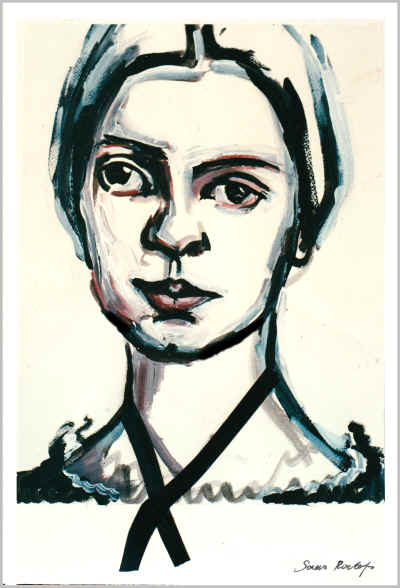
Portrait of Emily Dickinson
by Saar Roelofs
The poetess could know. She suffered from a chronic kidney disease that caused a
lot of pain. For that reason, she was forced to lead a secluded life. Her pain
and loneliness yielded beautiful poetry."
In the
novel
Van de koele meren des doods
published in 1900 by the Dutch writer and psychiatrist
Frederik van Eeden (1860–1932) numerous psychological themes
that I described in the foregoing are addressed. The Dutch
book, translated literally
into
The Cool Lakes of Death,
was in 1901 published under the title The deeps of
deliverance. The novel was adapted into a film in 1982 by
Nouchka van Brakel, starring Renée Soutendijk.
‘The story of a woman. How she sought
the cool lakes of death, where there is redemption, and how she
found it.’ This is how Van Eeden begins the novel about the
eventful life of Hedwig Marga de Fontayne. Although cheerful,
open and spontaneous, Hedwig has regularly fallen prey to
depressions since childhood and feels drawn to death. She
attempts suicide twice, experiences a psychosis, and ends up on
the streets of Paris as a morphine prostitute. But unlike her
literary peers Madame Bovary (Flaubert, 1857), Anna Karenina
(Tolstoy, 1877) and Eline Vere (Couperus, 1889) – who, like
Hedwig, are prisoners of the narrow-minded Victorian morality –
her life does not end with a self-chosen death, but in peace.
The
character Hedwig is a composite of various women in Frederik van
Eeden's life, including women he treated as a psychiatrist and
Jeanette, a morphine-addicted prostitute he had met in Paris.
The Cool Lakes of Death is written as a
quasi-biography.
Following the publication of the
novel, people wondered whether it was a case history. Van Eeden
responded to this in a brief foreword to the second edition. He
vehemently denies that the work concerns ‘a psychological study
of a more or less pathological case’, but rather that it
originated from an ‘aesthetic emotion for a spiritual process’.
Hedwig is not ‘morbid’, but due to her sensitive nature, she is
exposed more than others to the ‘harmful influences’ of society.
Van Eeden calls her ‘extremely finely and nobly organized’. In
our time, we would speak of ‘hypersensitivity’ (high
sensitivity).*
Thanks to her mental resilience, Hedwig manages to turn her painful
experiences to good account. According to Van Eeden, this is 'the
beautiful theme' he wanted to shape in his novel.
Van Eeden was well ahead of his time. In my
opinion, his views are still relevant today. At the end of the
novel, when Hedwig has a number of conversations in a hospital with
Sister Paula, a 'nursing sister' (or 'sister of charity'), he
presents his vision on the therapeutic process.
I would like to conclude Part 3 with
this, but first, a summary of Hedwig's life prior to those
conversations follows.
__________
*
Highly sensitive people have a deep emotional life, a rich imagination
and vivid dreams. They are averse to monotony, seek intense experiences,
and are sensitive to the – even unspoken – moods of others. As a result,
they have a great need for introspection and rest.
The cool lakes of death
Hedwig, a charming girl, grows up in the middle of the nineteenth
century as the child of wealthy parents. From early childhood, she
feels stifled by the dry monotony of bourgeois existence. Yet, she
is lively and spontaneous. At a very young age, she feels a longing
for something that transcends everything. Something that elevates
her life and fills her entire being. She experiences this
fulfillment in what she calls her ‘heart’s feeling’—moments in which
she intensely experiences her own individuality and fully senses the
‘now’.
Then she murmurs her name. ‘I, I, I – myself, I am Hedwig.’ These
moments carry a special significance for her. She never forgets
them. She holds intimate, deeply felt dialogues about this with God,
as if with a dear friend who knows and understands everything. After
such a heart’s feeling, she is cheerful for the rest of the day.
At the family’s country estate, Hedwig intensely enjoys nature. The
holidays too, when the drab reception room is transformed into a
‘splendid hall’, lift her above the monotony of daily life. The
small glasses of wine she receives and the compelling music sweep
her away. On such a festive evening, she spontaneously experiences
an orgasm. This is accompanied by a ‘heart’s feeling’ and confuses
her.
Religious education at school places eroticism and
sexuality in an atmosphere of guilt and shame. However,
the forbidden now becomes exciting and mysterious, and
therefore exerts an attraction on her. She develops
unbridled erotic fantasies. A housekeeper who takes over
the reins after her mother's death believes she must
'chastise' Hedwig for her sensual nature. When the
housekeeper, in a fit of rage, gives her a bloody nose,
Hedwig makes her first suicide attempt. Thus arises, in
the words of Van Eeden, "the separation of the intimacy
of the soul and the intimacy of the body."
At eighteen, she marries the kind-hearted Gerard. Like
Hedwig, Gerard has been damaged by the narrow-minded
sexual morality of his time. He is incapable of sexual
contact. The daily grind of her marriage becomes an
abomination to Hedwig. By chance, around that time, she
visits the small, impoverished farmhouse of Mrs.
Harmsen, who has just given birth to her seventh child.
Hedwig, who would love to be a mother, feels the need to
help. She enjoys it and discovers that peace is
something within oneself. Gerard realizes he must give
Hedwig a child. Hedwig "bore the unbearable." However,
she develops a physical aversion to her husband, to his
caresses, and to his presence. She does not understand
it because she truly loves him. Various doctors are
consulted. Hedwig is sent to an institution, where she
is "completely rubbed and pinched" by a young doctor, a
treatment that stimulates her sexually. Although she is
not attracted to the doctor and realizes he is acting
impurely, she finds it pleasant. Even when she undergoes
a cure "with electricity," the treating doctor cannot
keep his hands off her. Back home, she resumes her
aimless life. "And she came to hate everything she saw
and experienced." Hedwig decides to spend the summer
months in a hotel by the sea, hoping that the feeling of
aversion will fade and she will return to her home and
husband.
When she hears piano music by Beethoven, Chopin, and
Liszt in the hotel, she feels 'something hard melting
inside herself, something closed slowly opening up.'
Delighted, she thanks the pianist, Ritsaart, a handsome,
sensitive man, a bohemian who goes his own way. Within a
few days, the two are madly in love with each other.
Once she is back home, the lovers see each other
regularly, including at the home of Joob, an invalid
friend of Ritsaart. Hedwig has many conversations with
him. According to Joob, she feels unhappy because 'she
lets herself be served by two maids and has everything,
absolutely everything, done by others.' And that leads
to 'degeneration, boredom, world-weariness, dullness,
apathy, and the rest.'
In her naivety, Hedwig believes that she can keep
her relationship with Ritsaart ‘pure’. But in the
end, she is unfaithful to her husband. Gerard
guesses what is going on and threatens to murder
Ritsaart, which triggers Hedwig's second suicide
attempt. Once she has recovered from this, Gerard
banishes her from his life. She then leaves with
Ritsaart on a concert tour through England. When
they move into a cottage on the south coast of
England, Hedwig becomes pregnant. She finds peace,
but Ritsaart does not thrive in the quiet and
isolated place. He becomes impatient and resentful.
They argue regularly. Due to her pregnancy, Hedwig's
physical desire for Ritsaart decreases. Then, they
begin to doubt each other's love. Ritsaart,
accustomed to a nomadic life, sometimes leaves
Hedwig alone for weeks.
When he leaves yet again after an argument, Hedwig
gives birth prematurely to a baby girl. The child is
so weak that it dies after three weeks. Hedwig
suffers a psychotic episode. She packs the little
corpse into a bag along with her jewelry and leaves.
She wants to return to Holland, but is robbed of her
bag along the way and put on a train to Paris by the
thief. There, in her psychotic state, she is
admitted to the La Salpêtrière hospital.
_______________
* In the second half of the nineteenth century, La Salpêtrière was a
renowned center for research into dissociative disorders, among
other things, where many famous physicians worked or studied,
including Pierre Janet and Sigmund Freud.
Due to her agitation, she is locked in a
cell, watched with compassion by her attending physician. Day and
night she talks, sings, and rages continuously. Until, after six
weeks, she "awakens from her bewilderment." The doctor inquires
about her background, but Hedwig refuses to reveal anything. In her
anonymity, she feels free.
When she is discharged from the
hospital, she has nothing and no one. The doctor, captivated by
Hedwig, decides to take her into his home for the time being. He
also seduces her into sexual contact. "Not that she truly loved
him, but she felt grateful and inclined to please him, and at
the same time indifferent about herself, yielding and weak,
without resistance, due to the illness she had just endured."
When she finally rejects the doctor, he finds a room and a job
for her. Hedwig is afraid of her psychosis returning. For this
reason, the doctor gives her morphine. She becomes addicted. Her
income is not sufficient for her daily doses. Thus, she ends up
in prostitution.
Despite everything, her resilience is
not broken. Sometimes she is truly cheerful and upbeat.
Surprised, she observes: one would say I am much unhappier than
before, and yet I think less about suicide. But the addiction
takes its toll. She falls ill. When she faints on the street one
day, she is taken to a hospital. There, she suffers severely
from withdrawal symptoms. For days, she lies feverishly gasping
and cannot keep any food down. When, out of a craving for the
drug, she secretly uses morphine from a hidden bottle and denies
this to her attending physician, he calls in the help of "Sister
Paula from the upstairs ward." Because she knows exactly how to
handle this.
Sister Paula takes Hedwig's hand and
says in a soft voice: "You are lying, and you do not want to
lie. What you want, you do not do; what you do not want, you do.
(...) Shall we try it again together now with the last bit of
your willpower? Only a little bit more is needed. Just imagine
that you are struggling against a fast mountain stream. Just a
little further… a very little way… then the still waters will
come." Full of shame, Hedwig hands her the bottle. "Now it is
well," Sister Paula says. "Now you have done enough for the time
being. Now you may rest." In the days that follow, Sister Paula
regularly comes by to give Hedwig a little encouragement.
The
Underlying Theme
After the worst withdrawal symptoms have subsided, seven
conversations with Sister Paula follow. These conversations can
be interpreted as a form of short-term psychotherapy. In them,
Van Eeden presents his vision on healthcare, which remains
relevant today.
The
resilience of the help-seeker Sister Paula puts Hedwig’s life into
perspective. She shows her the guiding thread in her
life. Hedwig returns to Sister Paula's 'still waters'
and says: 'I have always wanted to be dead. I longed for
that profound peace. I called it: still waters, green
pastures, cool lakes.' 'Pay attention now,' says Sister
Paula, 'there is a life that is death, and there is a
death that is life.' Hedwig sought physical death.
Sister Paula shows her that 'the cool lakes of death'
are actually attainable during life. That she can find
peace. Satisfaction, fulfillment, and the joy of living.
Through this, Van Eeden
expresses his view that, despite heredity or
environment, a person is free to choose how they shape
their existence. In his own words: a person can go
through the deepest depths and yet rise to great inner
heights. Thus, he has Sister Paula say: 'Your disorders
do not touch your deeper self.' And: 'You know that you
have been enlightened by your misery. You know, even
more than you knew.' But Sister Paula understands that
this is difficult for someone who feels miserable to
comprehend as long as they have not yet discovered the
'treasure in suffering'. She believes, however, in
Hedwig's resilience and is convinced that she will find
her treasure – just as the exemplary figures from the
previous chapters found their treasure.
Like many people with mental health issues, Hedwig did not seek help on her own initiative. She is only able to reach a turning point once she has ended up in an inescapable situation. She tells Sister Paula that she did not seek help because she was ashamed of her shortcomings. Sister Paula believes that this is actually 'pride', 'an aversion to enduring your flaws'. According to Sister Paula, if Hedwig had been willing to face her mistakes and could have accepted herself as she was, she would have turned her life around sooner.
The neutral empathy of the therapist In the book, Van Eeden shows between the lines that, as a psychiatrist, he advocates an attitude of neutral empathy, as I described in Part 2. In the final paragraph of Chapter 11, Difficult' clients" I showed how a contemporary therapist suspects his client of heroin use and tries to force a confession from her like a police officer. How different is Sister Paula's attitude. Her calm, empathetic behavior quite quickly leads Hedwig to admit her morphine use.
In a passage from Part 2, Haughtiness and Inferiority, it was discussed that therapists find it hard to imagine that their clients possess resilience independently of the care they receive. That, within the hierarchical therapeutic setting, they are easily tempted to believe that they are 'further along' in their psychological development than their client and have already processed their emotional problems. Sister Paula does not get caught up in such therapeutic pitfalls. When she notices that Hedwig is idealizing her, for example, she warns: 'It weighs on me and it is untrue. (…) My life is just as full of mundane, boring, somber difficulties and worries, just as full of hesitations and weaknesses as that of other people.' And when she occasionally becomes irritable without justification, she readily admits it in the next conversation.
Sister Paula leaves Hedwig in control of her life, no matter how deeply she cares for her. She offers her no advice. Her motto is: act sincerely, but without fear, whatever the consequences may be.
Furthermore, she is careful not to let the love-starved Hedwig become attached to her. When Hedwig asks if she can write upon leaving, Sister Paula protects her from a lasting dependency: "Better not. It is already enough."
The 'Now'
Hedwig decides to return to Holland and help out at Mrs. Harmsen’s farm. As a newlywed woman, she experienced an intense peace there for the first time. She has a room built onto the farmhouse overlooking a lake. During the day she helps with the household and on the land, and in the evenings she reads and writes in her diary.
"It was far from an idyllic life," writes Van Eeden. But despite fatigue and gloomy moods, Hedwig is "wonderfully happy."
She finds joy in simple, everyday things. With her sensual nature, she thoroughly enjoys nature, "the dewy spiderwebs, the little moss plants on the roof, the quiet pale mist, the fresh spring green, and the evening sky over the lake." The moments in which she fully experiences the "now" - the "heart-feelings" from her childhood - no longer last for mere minutes, but for hours, and sometimes even days. Thus, she experiences an ever-increasing sense of peace and the joy of living.
Dragons and
princesses
People in
psychological
distress are
capable of
tapping into
unsuspected
inner strengths
that defy all
psychiatric and
psychological
frameworks. Of
paramount
importance is a
person’s
resilience, the
strength of
their capacity
for growth, and
the magnitude of
their desire to
turn the tide.
Because, as the
writer and poet
Rainer Maria
Rilke
(1875-1925) asks
in his
Letters to a
Young Poet:
How could we
forget the
ancient myths
that stand at
the cradle of
all peoples —
the myths about
dragons that at
the very last
moment turn into
princesses;
perhaps all the
dragons in our
lives are
princesses who
are only waiting
to see us look
beautiful and
brave just once.