|
REVIEWS
"An
eye-opener for care therapists and clients regarding an
important issue." NBD/Biblion,
JP Bringman.
"Saar
Roelofs shares sincerity, commitment, and respect for the
patient's perspective with the well-known psychiatrist Irvin
D. Yalom." "With striking cartoons of her own making."
IdR. Newsletter Foundation for Patient Confidentiality, 2008.
"This is a
thought-provoking book that offers
a good counterweight in these times of protocol-driven
treatments."
" Saar
Roelofs focuses on the creativity and resilience of patients.
She also refers to the resilience of artists and Holocaust
survivors. She
rightly points out that people in exceptional situations often
exhibit enormous growth potential, from which we as therapists
can still learn a great deal."
"There is
and remains far too little attention in training to basic
relational dynamics, such as the use of patients by care
providers for their own narcissistic purposes." [This refers
to countertransference in
part 2 of the book, SR]. "It is good that Roelofs puts her
finger on the sore spot." (Dutch)
Journal of Psychiatry 5, 2009, Patrick Luyten.
"The author,
seasoned in the world mental health care, is a master at
keeping both feet on the ground and looking at what all the
work [in mental health care] yields." "This shows how some care
providers consider themselves indispensable (...) and also how
powerful clients are, despite all our problematizing." Social
Psychiatry, August
2008, Gerard Lohuis.
"A justified
argument against making people dependent on professional care.
Illustrated with original cartoons that provide clarity.
Lively case studies."
Dutch Journal
of medicine, December 13, 2008, PC Bügel
"Many
clarifying illustrations and cartoons." Care +
Welfare, August 2008.
"This book
is a thorough reflection on everything that happens behind the
door of the consulting room."
"An
extraordinarily supportive message for everyone in
psychological distress." Zinweb,
July 6, 2008, Marga Haas.
"This
critical view of psychiatry is refreshing." Nederlands
Dagblad, May 28, 2008, Martha Aabers
The book
provides insight into the treatment processes in the mental health care." Pandora
Foundation, October 2008, Dror Shoshan.
"Clear and
practical - with examples and many fun cartoons you can relate
to." Agis
Health Insurance Patient Information, 2008, Herma Coumou
"A
well-crafted book. Well-argued. Rich in examples. The cartoons
make situations clear in an instant." PLUSminus,
quarterly magazine of the Association for Manic Depressives
and Relatives, December 2008, Alette van Bentum.
"Insightful
and clearly written" "All kinds of terms are explained in an
accessible way. It is very easy to read." NetCliënten,
2008.
On LinkedIn :
- Kim
Koumans, whistleblower who exposed the culture of abuse in the
dance sector: "This
was my first book when I entered the mental health care; I still
read it regularly."
- Organizational
psychologist Kim Castenmiller: " I read
this book of my own accord, but there was no attention paid to
this during my training. A missed opportunity, because I
believe this book should be mandatory reading."
Wikipedia "Antipsychiatry
in the
Netherlands is
represented by, among others, Kees Trimbos [after
whom theTrimbos
Institute is
named, SR],
Jan Foudraine, and later Saar Roelofs on the
institutional side."
|
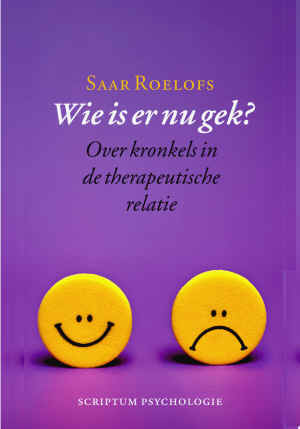
Who is crazy actually, a book
about the mental health care publised in 2008, is Saar
Roelofs' credo as a psychologist. The book is based on
her years of experience in the mental health care – as a
scientific researcher (PhD), manager, and clinical
psychologist/behavioral therapist.
The gist:
The boundaries
between "healthy" and "sick" are not as sharp as is
often assumed in the mental health care.
The book offers
critical observations on the Diagnosis
Treatment Combination (DBC),
shows how treatment can derail due to unresolved
emotional problems of the therapist, and describes how
people in psychological distress - also without
professional help - are capable of tapping into
unsuspected inner strengths. Richly illustrated with
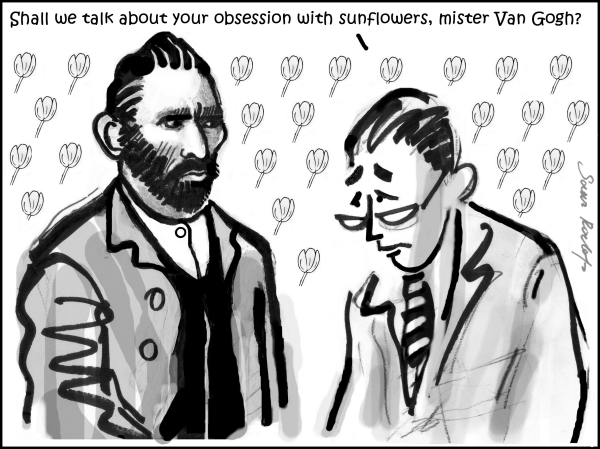
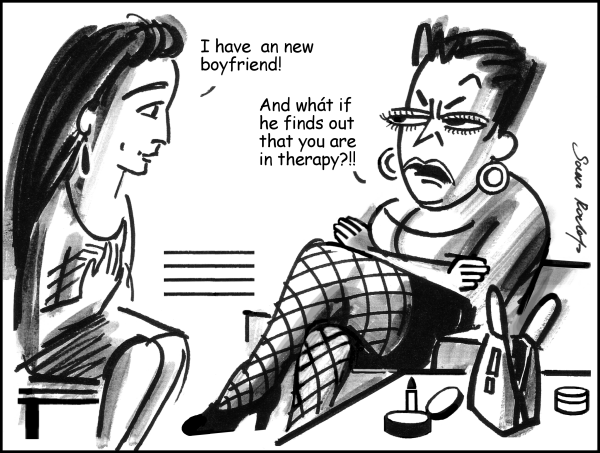
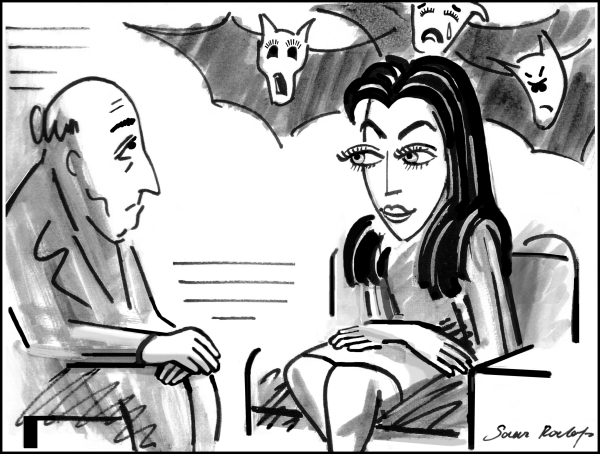
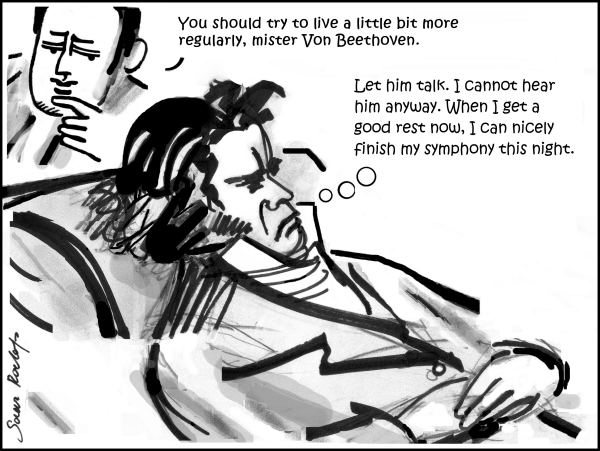
practical examples. It also includes 68 cartoons by
the author.
According to the
author, art is a source of inspiration that can
contribute to insight and mental growth.
Consequently, the reader will find many references to
visual art, literature, and music in the book.
With this book, she
aims to strengthen the trust in the own perception,
vision, and judgment of people who are in or about to
start therapy.
Who is
razy actually? starts
with Personal
Motivations.
Part 1, Sparse
diagnostics, rigid treatment. As
in her book Do not disturb (1997), the
author points out the serious shortcomings in diagnostics
when using the Diagnostic and Statistical
Manual of Mental Disorders (DSM ).
Her main points of critisism:
The DSM
is not suitable for diagnosis;
PTSD is often mistakenly considered a personality
disorder; psychiatric judgment by the therapist can lead
to self-condemnation by the client.
She describes which diagnostics and treatment
would benefit both the therapist and the client more. She
also explains her reservations regarding the Diagnosis
Treatment Combination.
Part 2, The therapist on the
couch.
In this part, the so-called countertransference of the
therapist is explored in detail.
The
world of mental health care still consists of two halves:
that of the 'healthy' therapists and that of the
'sick' clients. Yet these dividing lines are not at all
easy to draw. The therapist, too, is not immune to human
frailties. Excessive or insufficient involvement with the
client, pride and inferiority, power and powerlessness,
jealousy or sexual abuse: it all occurs, regardless of the
therapist's treatment methods or theoretical premises.
As a result, clients can go from bad to worse. Using
detailed case studies, the author explains how treatment
can derail due to the care provider's unresolved emotional
problems.
Read passages from part
2.
Part 3, The
resilience of the help-seeker.
The
final part addresses the
fact that therapists can make greater use of clients'
resilience. As in
her book Turning
point (2004),
the author demonstrates, using various practical examples,
that people in psychological distress - even without the
intervention of professionals - are capable of
tapping into unsuspected inner strengths. Therapists could
make more use of this. Among others, she highlights the resilience of two Auschwitz survivors. Finally,
the visionary perspective of the renowned Dutch
psychiatrist and writer Frederik van Eeden (1860–1932) is
discussed with a review of his novel
Van de
koele meren des doods (translated
as The Deeps of Deliverance).
Here, all the threads laid out in the book converge.
Read
Part 3.
See also:
Entangled in the
mental health care
(passage from Saar Roelofs' book Do not disturb
(1997)
Triptych on the mental health care
Who is crazy actually? forms,
together with Saar Roelofs' book
Do not disturb (1997) and her e-document
No talent for conformism
(2024), a
critical, still relevant
triptych on
the Dutch mental health care.
Up
|